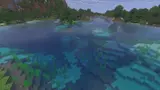
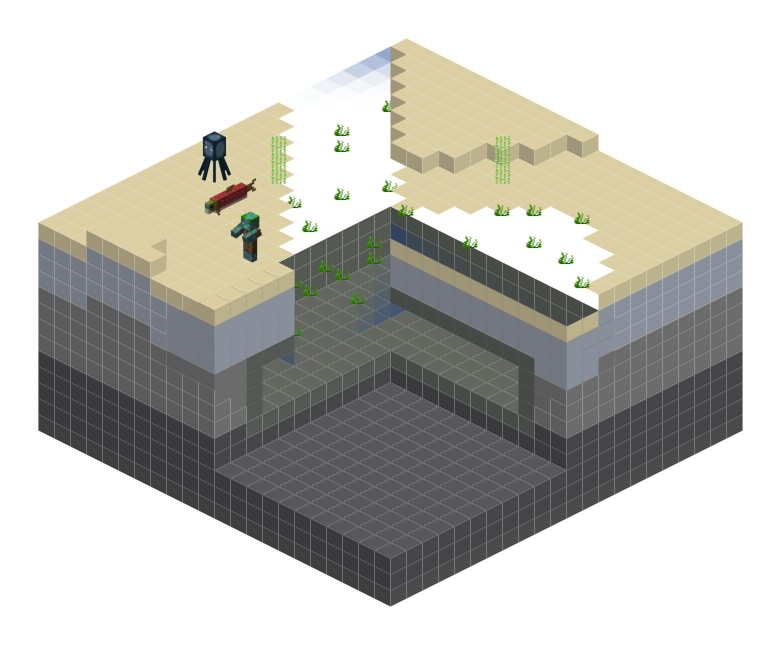
River

Rivers cut through the landscape connecting biomes. Good source of clay and sand. Drowned can spawn in rivers at night.
Overview of River
A river is a thin biome that goes everywhere. It cuts through whatever it passes, connects biomes that would otherwise never touch, and drops clay, sand, gravel and sugar cane along its banks.
Under the surface it behaves unlike any other water: far fewer fish generate here than in the sea, and drowned turn up more often than they do elsewhere. Squid and salmon are the rest of the list. An ocean monument cannot generate without water like this around it, which is a detail worth knowing before you dig one out.
Temperature 0.5 and humidity 0.5 make it mild and temperate, with rainfall rather than snow. minecraft:river has been carving worlds since Beta 1.8, it is common wherever land is, and 26.2 still threads it between everything else.
Where to find River
Rivers run through the Overworld and touch nearly everything on the way. Plains, Forest, Swamp and Beach are the four listed against it, though a single channel will cross far more than that.
Rivers thread between almost every biome, so follow any flowing channel of water across the map.
Common, and it is the road rather than the destination: follow the water by boat and it hands you the biomes on both banks. Clay and sugar cane come off the edges, salmon out of the middle. Ordinary exploration is all the work needed: a border between any two biomes usually has one running along it, so following the water is the same as following signposts, and you meet everything else on the way.
Mobs in River
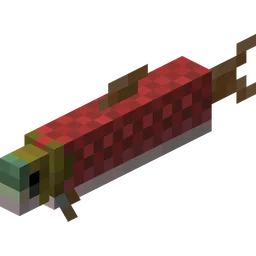
A river is a fishing spot with one problem in it. Squid and salmon both fill their spawn slot completely, squid one to four at a time and salmon in shoals of one to five, and the salmon is the cold-water food fish that makes a river worth a fishing rod at all. Squid drop ink sacs, the start of black dye and of a book and quill.
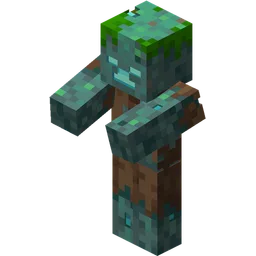
The problem is the drowned, on roughly 1 in 6 attempts. It is the underwater zombie, it can be holding a trident, and it drops nautilus shells whether it is or not. Rivers put more of them in your way than open water does, so swim across rather than along. You can turn your back on both fish. The squid, for example, drops ink sacs, used for black dye and for books and quill, and cod give bone meal and cod, while the numbers behind the drowned put it at a sixth of the hostile spawns; it is an underwater zombie, sometimes wielding a trident. Salmon keep to themselves in shoals. A drowned will wield a trident when it has one.

River blocks & resources
Clay and Sand line the river bed in quantity, and that is the reason to bring a shovel rather than an axe: a single bend can hold enough clay for a full run of bricks and terracotta. Gravel sits in the same floor and gives flint on the way.
Sugar Cane grows on both banks, so paper and books come out of the same trip. Most trips here are for sugar cane for paper and books and clay for bricks and terracotta, and a river near spawn covers both before you have a proper farm.
Rivers get their own seagrass planting, thinner than the sea version, so the bed is visible instead of hidden under a lawn.
In terms of mining, a river bed is the one place clay comes planted in whole pockets rather than one block at a time, and it plays by the rules of whatever biome it runs through for everything else.
The sand banks are where the cane stands and where the clay stops.
 Sand
Sand Clay
Clay Gravel
 Sugar Cane
Structures & features in River
A river is a corridor, not a destination, and it has no build to call its own. What it gives you is the narrow water channel itself, clay in the banks, sand and sugar cane along the edges.
That still makes it useful. Follow one far enough and you cross most of the biomes it runs through, while under the water the underground carries on unchanged: mineshaft tunnels beneath the bed, dungeon rooms off the sides, and now and again a stronghold can be dug up beneath the channel. Scenery, sugar cane and clay are what exploring a river rewards, rather than buildings, and what was generated beneath the channel, dungeons and mineshafts and an occasional stronghold, is tied to no biome at all. World generation ignores those boundaries entirely, which is why such a tunnel is as likely under water as under land.
 Temperature
 Precipitation
 Version Added
 ID
IDRiver biome colours
A river takes the ocean group's grass and leaves and the standard blue water, and adds nothing visual of its own. The general music is written in. What a river does have is the same three carvers as the land around it, which is why a river so often runs straight over a cave and drops you into one.
River terrain features
- -narrow water channel
- -clay deposits
- -sand banks
- -sugar cane
River: what generates per chunk
Forty eight passes and exactly one of them is the river's own: seagrass at 48 tries per chunk, the same rate the ocean gets. Everything else that runs here is the standard Overworld list, which is why a river bank looks like whatever biome it is cutting through.
River: spawn rules and variants
Two rules that apply to almost nothing else apply here: drowned spawn more often in a river than in open sea, and the ordinary water ambient spawns are reduced, so the fish thin out where the drowned thicken.
Squid and salmon are still the everyday catch, and rivers are one of the thirteen biomes drawn as water on a map.
River: structure depths and spawns
A river builds nothing of its own. The mineshafts, the stronghold and the chambers underneath belong to the land it cuts through, and the portal that generates in the water is the standard version.
That is worth knowing when you follow a river looking for something: the water is a road, not a destination.
Which biomes border River
Around River the temperature runs from 0.7 to 0.8, against 0.5 here.
- Plains: 0.3 warmer at 0.8, Cow, Pig and Sheep come in, no more Squid, Salmon and Drowned, with Village and Pillager Outpost on that side.
- Forest: 0.2 warmer at 0.7, Cow, Pig and Sheep come in, Squid, Salmon and Drowned stay behind, with Abandoned Camp on that side.
- Swamp: 0.3 warmer at 0.8, Slime, Frog and Bogged come in, Squid, Salmon and Drowned stay behind, with Swamp Hut and Abandoned Camp on that side.
- Beach: 0.3 warmer at 0.8, Turtle turns up, no more Squid, Salmon and Drowned, with Buried Treasure on that side.
What the mobs in River drop
Everything that spawns in River is worth something. Between them the mobs here drop 5 different things: ink sacs, bone meal, salmon, copper ingots and rotten flesh.
100 percent of the water animal draw in River goes to Squid, so ink sacs is what this biome hands out most.
What River is good for
A river is the cheapest sugar cane in the game: it grows along both banks, it regrows, and it turns into paper and books without any farm to build. Clay sits in the riverbed for bricks, and sand and gravel line the banks.
Squid spawn in river water for ink sacs and salmon for food, and drowned turn up more often in a river than in most other water, which is worth knowing if you plan to swim it at night. Rivers also lead somewhere, which is why so many worlds follow one home.
How to find River
Rivers thread through everything, so the nearest one is rarely the one you want, and to pick the biome out, try the /locate biome call, which names the channel itself instead of the bank you happen to stand on:
A channel requires cheats to be enabled on the world the channel runs through, or operator permissions on a server, while clay in the bed proves the command put you in it rather than beside it, whichever bank you use to get there.
River on Java Edition against River on Bedrock
A river is a river in both editions, at temperature 0.5 and downfall 0.5, and /locate biome river works the same on each.
The colour is where they part: river water is the default #3F76E4 on Java and a far more saturated #0084ff on Bedrock, which is why a Bedrock river reads bluer against the land it cuts through.
| River | Java | Bedrock |
|---|---|---|
| River in /locate biome | minecraft:river | minecraft:river |
| River temperature | 0.5 | 0.5 |
| River water colour | #3F76E4 | #0084ff |
| River snow depth, blocks | n/a | 0 to 0.125 |
River name and version history
Unlike the eleven biomes that were renamed along the way, River has been River in all 51 releases since 1.13. It was added in Beta 1.8.
- Beta 1.8River starts generating
River: which advancements count
River is on the Adventuring Time list, the advancement whose text reads "Discover every biome" while it really means 56 of the 67. River sits in the temperate group, 16 biomes strong.